

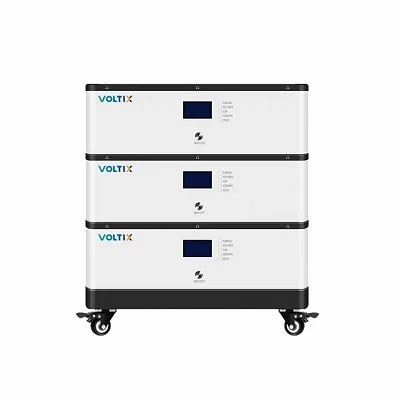
Product Overview
The Commercial Off-Grid Energy Management System (EMS) is engineered for autonomous power dispatch, peak shaving, and microgrid stabilization in areas lacking stable utility grid infrastructure. Integrating lithium iron phosphate (LiFePO₄) battery storage, bidirectional inverters, and an intelligent central control unit, the system coordinates power generation from photovoltaic arrays, diesel generator sets, and local loads.
Designed for continuous industrial operation, the system features a modular architecture that scales from 50 kWh to multi-megawatt configurations. It monitors real-time state of charge (SoC), state of health (SoH), thermal performance, and load demand to maximize renewable energy self-consumption and ensure uninterrupted power supply for remote industrial sites, telecom base stations, and commercial facilities.
Key Specifications
|
Technical Parameter |
Specification Value |
|
Nominal System Voltage |
51.2V DC (Modular scaling up to 800V DC high-voltage architectures) |
|
Battery Chemistry |
Lithium Iron Phosphate (LiFePO₄ / LFP) |
|
Single Module Capacity |
100Ah / 5.12 kWh (Scalable rack configurations) |
|
Inverter Compatibility |
Off-grid / Hybrid bidirectional inverters (MPPT integrated) |
|
Communication Protocols |
CAN 2.0, RS485, Modbus TCP/IP, Ethernet |
|
Maximum Efficiency |
≥ 98% (Inverter peak efficiency), ≥ 95% (Round-trip system efficiency) |
|
Operating Temperature Range |
−20°C to +55°C (Active temperature regulation enabled) |
|
Enclosure Protection Rating |
IP55 / NEMA 3R (Outdoor weatherproof deployment) |
|
Cooling Mechanism |
Forced air cooling with intelligent temperature-controlled fans (Liquid cooling optional) |
|
Design Life / Cycle Life |
≥ 6,000 cycles at 80% DoD (25°C, 0.5C/0.5C) |
|
Safety Certifications |
CE, UN38.3, IEC62133, RoHS; ISO9001 / ISO14001 manufacturing standards |
Key Product Characteristics
Advanced Battery Cell Sorting and Grading: Utilizes automated cell grading equipment to match internal resistance, voltage, and capacity within tight tolerances prior to module assembly, preventing localized cell degradation and extending total pack life.
Redundant BMS Architecture: Features a dual-tier Battery Management System (Primary BMS per module + Central BCU) monitoring real-time voltage, current, and cell-level temperature to prevent overcharge, deep discharge, and thermal runaway.
Precision Thermal Management: Integrates automated temperature sensors and dynamic airflow channels to maintain operating temperatures within the optimal window, mitigating capacity fade in extreme climates.
Rugged Industrial Construction: Fabricated using cold-rolled steel enclosures processed via precision laser cutting and automated welding, finished with corrosion-resistant outdoor powder coating for harsh environments.
Modular Plug-and-Play Scalability: Standardized 19-inch rack-mount architecture allows parallel and series configuration expansion without complex rewiring or downtime.
System Architecture & Core Modules
An operational Off-Grid EMS deployment consists of five primary subsystem modules:
Energy Storage Subrack: Houses modular LiFePO4 battery packs with integrated fusing, busbars, and module-level monitoring boards.
Central Control Unit (CCU / EMS Master): The data processing core that runs real-time dispatch algorithms, energy forecasting, and generator auto-start protocols.
Bidirectional Power Conversion System (PCS): Converts DC power from the battery bank and solar array into synchronized AC power for local loads, or vice versa during grid/generator charging.
Solar MPPT Combiner Unit: Manages multi-channel photovoltaic string inputs, optimizing solar harvesting efficiency before DC bus integration.
Auxiliary Power Distribution & Protection Panel: Houses grid-tie/off-grid transfer switches, surge protection devices (SPD), circuit breakers, and emergency stop mechanisms.
Applications
Remote Microgrids & Island Electrification: Replaces or offsets heavy diesel generator reliance in isolated communities, mining camps, and island microgrids.
Commercial & Industrial (C&I) Peak Shaving: Suppresses demand charges by discharging stored energy during peak industrial load intervals.
Telecom Base Station Backup: Provides reliable, maintenance-free DC/AC power backup for off-grid cellular towers and communication relays.
Utility Construction & Temporary Camps: Delivers mobile, modular, and containerized power infrastructure for remote infrastructure construction sites.
Compatibility & Integration
Generator Integration: Features dry-contact signal outputs and automated logic controllers to auto-start and throttle backup diesel generators when state-of-charge drops below configurable thresholds.
Solar PV Array Integration: Compatible with standard string and central inverters via DC coupling or AC coupling topologies.
SCADA & Remote Monitoring: Supports standard industrial communication protocols (Modbus RTU, Modbus TCP, SNMP) for seamless integration into third-party plant SCADA systems and cloud telemetry platforms.
Load Compatibility: Designed to drive inductive motors, heavy pumps, and sensitive electronic loads with low total harmonic distortion (THD < 3%).
Supply & Customization Options
OEM / ODM Services: Custom enclosure dimensions, specific voltage configurations (e.g., 24V, 48V, 110V, 380V DC buses), customized firmware logic, and private-label silk-screening available for volume orders.
Form Factor Options: Available in wall-mounted cabinets, floor-standing server racks, and fully integrated ISO containerized power stations.
Logistics & Packaging: Export-grade wooden crating with moisture-barrier vacuum sealing and shock-absorbent cushioning suitable for international sea and air freight.
Minimum Order Quantity (MOQ): Flexible sample orders for pilot testing; scalable volume pricing for project EPC contractors.
Quality / Testing
Every EMS production batch undergoes strict factory acceptance testing (FAT) before shipment:
Cell & Module Level: Automated cell sorting, laser-weld integrity inspection via optical sensors, and initial capacity calibration.
BMS Calibration: Hardware-in-the-loop (HIL) simulation testing to verify protection trip thresholds and balancing current accuracy.
System Burn-In & Cycle Testing: Full-system charge-discharge cycling under simulated thermal loads using programmable battery cycle testing systems.
Electrical Safety Screening: High-potential (Hi-Pot) dielectric withstand testing, insulation resistance testing, and earth continuity checks.
FAQ
Q: What is the typical lifespan of the off-grid energy storage system?
A: The system uses LiFePO₄ cells rated for ≥6,000 cycles at 80% DoD and 25°C under specified test conditions. Actual service life depends on operating temperature, depth of discharge, charge/discharge rate, and thermal management.
Q: Can the EMS integrate with existing diesel generators?
A: Yes. The system includes programmable dry-contact relays and logic controllers that automatically signal a diesel generator to start when battery state-of-charge reaches a pre-set low threshold or when heavy load surges exceed inverter capacity.
Q: What communication interfaces are available for remote monitoring?
A: The system supports RS485, CAN 2.0, Modbus TCP/IP, and Ethernet ports, allowing local HMI touchscreens as well as remote connection to web-based SCADA or IoT cloud dashboards.
Q: What is the standard lead time for standard units versus customized OEM orders?
A: Standard configurations ship within 15 to 25 business days. Tailored OEM/ODM solutions typically require 35 to 50 days following engineering drawing and firmware sign-off.
Hot Tags: off-grid energy management system, China off-grid energy management system manufacturers, suppliers, factory